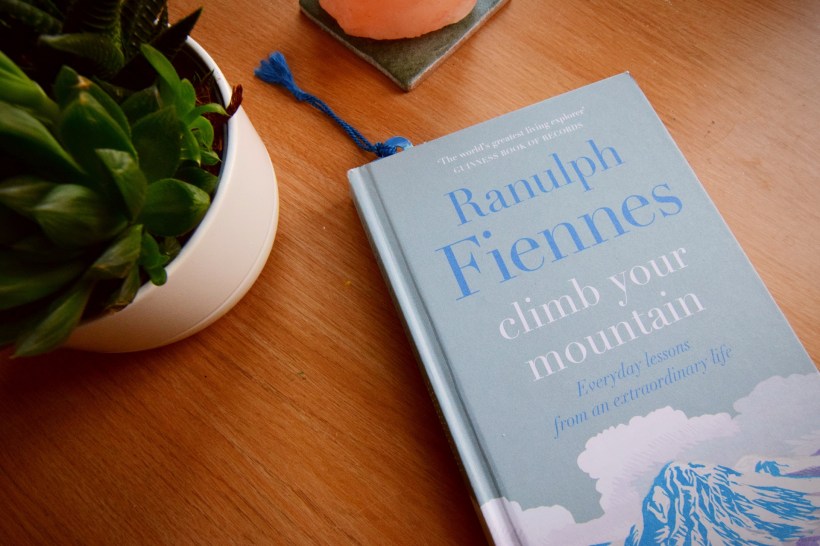
I’ve just finished reading Sir Ranulph Fiennes’ new book, Climb Your Mountain, and it is a beautiful tribute to how tackling physical mountains can assist with the even-bigger internal climbs we face. Climb Your Mountain is all about weathering the storms of everyday life, from a man who has braved the most perilous conditions Planet Earth can throw at a human. His is a tale of stupendous endurance, from which we can all learn.
My current mountain
If you’ve been following my blog for the last little while, you’ll know I’m not managing to get *out there* at the moment because my mountains are much closer to home. The challenge I am preoccupied with is healing from a suspected case of mast cell activation sydrome – MCAS for short. Healing from MCAS requires a significant reduction in autonomic sensitivity to histamine, stress, and inflammation within my body, rewiring my nervous system, and retraining my brain not to overreact to environmental stimuli. In essence, I am relearning how to process the stressors everyday life throws at me, after recent repeated incidences of immune system failure.
I write this not long after receiving a frustrating letter from an immunologist at the clinic I was due to visit yesterday to discuss possible treatment options. Unfortunately, the clinic cancelled my appointment on the basis that the condition is ‘too complex’, involving too many interrelated systems of the body for any one department to address. The letter described how I would need to go through multiple strings of long appointments, seen by doctors in various specialist fields, which the clinic, nor the NHS, could not accommodate in time or resources.
Holistic hope on the horizon
Initially, at this I felt lost and disappointed, but then I recalled the work I’ve been doing over the last two months to understand the condition, its triggers, causes, and constellation of symptoms from a holistic perspective. I remembered how other histamine sufferers across the internet and Instagram, especially women (MCAS is much more common in women), have addressed it by their own merit through natural healing modalities. A major shout-out is due here to holistic healers, Laura Lyons and Annika Nicole of Wild Lyons Wellness, Beth at Mast Cell 360, and Claire, founder of Through the Fibro Fog, for building the foundations of my own, ongoing healing process. I have been incorporating many of their collective natural recipes and remedies for lowering inflammation, as well as counteracting histamine release with the natural anti-histamines found in stinging nettle tea, red onions and apples (both containing the anti-histaminic protein quecertin), bromelain, high-quality mineral salts and Vitamin C. However, I am also discovering that, even more powerful than these, is the mind. A strong mindset has been shown to biochemically induce healing from the top down, and even combat one of the most potent causes of disease in the world today: chronic stress.
“A strong mindset has been shown to biochemically induce healing from the top down, and even combat one of the most potent causes of disease in the world today: chronic stress.”
Mind over atter: consciously reprogramming the nervous system
I am not going to pretend I know more about the mind than I do; I am not a pscyhologist. But I can certainly attest to the power of a strong and healthy mind in combatting physical illness. I can also speak for the limiting and debilitating impacts of an unhealthy mindset having the opposite effects. Mindset is everything.
For me, ‘mind over matter’, far from being a macho, military order, is a reminder that I have the conscious ability to reprogramme my nervous system, thereby drastically improving immune system function. In other words, with simple practices that usually cost very little, I can escape the stress loop that drives up blood cortisol levels and mast cell and histamine release.
There are many ways that anyone (not just MCAS sufferers) can work towards reprogramming their nervous systems and, therefore, immune systems. The ability to do this is becoming increasingly important as society drives towards a cellularly destructive ‘always on’ state. A healthy nervous system should be able to ‘switch’ between the sympathetic (active) and parasympathetic (relaxed) states with ease. Practicing exercises that ground the nervous system over time speeds up this transition, gradually bringing the nervous system into balance, and the more this is done, the easier it is for the body to enter its natural healing state, and recover when stressors are faced. It’s a form of work hard, play hard. If the science of this sounds interesting to you, check out this illuminating video from Therapy in a Nutshell.
Amongst the best practices for grounding the nervous system are breathing and mindfulness techniques. Out of pure necessity (i.e., to get out of an MCAS attack) I have found that performing long, conscious inhalations and even longer exhalations worked pretty well. By actively encouraging my body into a calmer mental state, telling it that is safe, my nervous system would gradually get the message too, and switch from the sympathetic to the parasympathetic state. This would usually take between 10 and 30 minutes, but could often be a really powerful transition.
However, there are many other helpful ways I’ve found to calm the nervous system after a period of illness and chronic stress, some of which I’ve listed below and which may be helpful for others to discover, too. Clearly, some techniques require a certain physical environment, but the breathing techniques, yoga, prayer and meditation can be done anywhere, even up a mountain, if you like.

Breathing techniques: Long inhalations, even longer exhalations; square breathing, yoga, prayer and meditation.
Gentle to moderate exercise: walking, swimming, yoga, Pilates, you name it.
Being in nature: Forests, beaches, mountains and rivers.
And finally, over time I found that happiness may well just be the best anti-histamine and nervous system regulator there is. In ancestral terms, being chased by a hungry pack of wolves is not going to be a time for joy because you’re in the fight-or-flight state, but once huddled with your tribe into the safety of camp, with a warm fire going, happiness and laughter will be natural. These emotional states are signals to the body that it is safe, so that it can wind down and destress. Since our brains haven’t fundamentally changed since primeval times, our nervous systems are still wired much the same, which means, with these techniques, we can ‘reprogramme’ relaxation. I think that’s an incredible evolutionary ability.
Climb your mountain
I’ve spent most of this post talking about the nervous system, and what I’ve learnt to do when its basic functioning is out of whack. But what has this got to do with Ranulph Fiennes’ new book I mentioned at the start? And how does learning how to reprogramme your nervous system help you to ‘climb your mountain’?

Over his remarkable lifetime, Fiennes was no stranger to life-threatening situations. These may not have been MCAS or anaphylaxis, but fighting in an active Omani warzone, man-hauling for months unaided across Antarctica, and setting out to climb the North Face of the Eiger, with already-frostbitten fingers thanks to a previous incident of falling into ice-water in the Arctic Ocean are all death wishes by any normal standards. It would surprise most, then, to learn that the man also has held a lifelong fear of heights, but ‘So much of fear is in the idea of the thing you are afraid of, the anticipation.’ Avoidance breeds anxiety.
‘So much of fear is in the idea of the thing you are afraid of, the anticipation.’
Sir Ranulph Fiennes
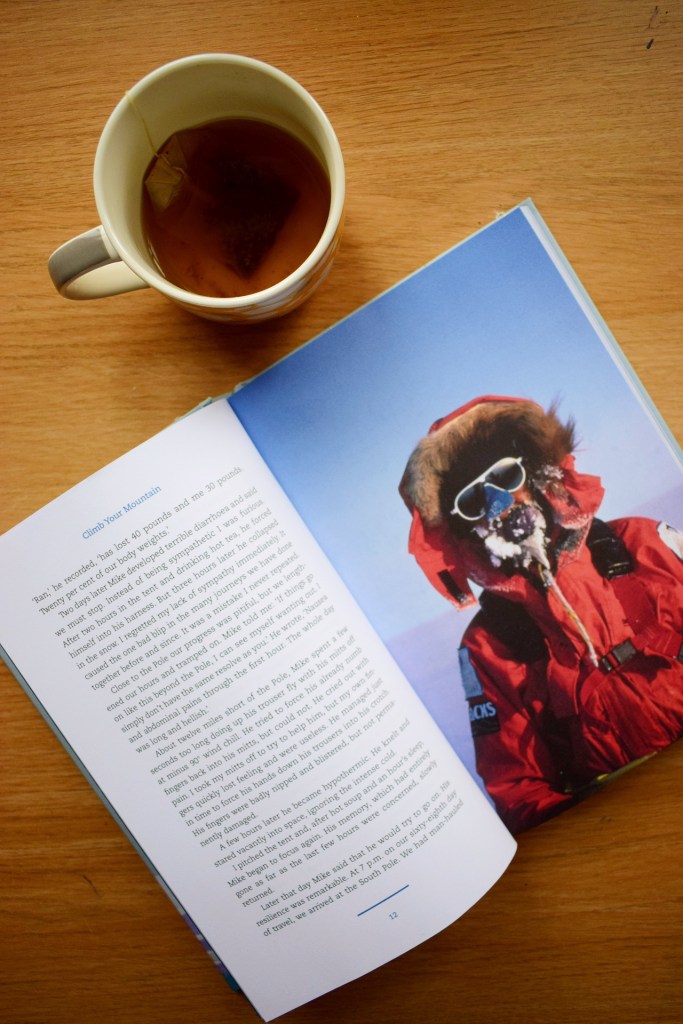
In Climb Your Mountain, Fiennes sweeps across his lifetime of adventure, sharing his arresting stories of endurance, exploration, and overcoming, with periodic interruptions that bring the book back to the present, to reality, to real life, and how each one of us can take the hard lessons from Earth’s frozen landscapes into everyday life.

The chapters are by no means chronological; they are divided as per facets of any human life: Ambition, Teamwork, Leadership, Failure, Facing Fear, etc., and each is filled with hard-fought wisdom. For example, in ‘Wonder’ Fiennes describes segments of his Transglobe expedition, in which he and partners Charlie Burton and Oliver Shepard (neither professional explorers) completed ‘the first circumnavigation of the Earth’s polar axis’ without aeroplane support. Of their mind-bending journey, which took place from September 1979 to August 1982, Fiennes remarks, ‘there is always light at the tunnel’s end and that is what you must think about.’ For me in this time of healing and learning to reset, the lessons across the adventures in this book are invaluable, and I will surely value its inspiring effect on me for a long time to come.
‘There is always light at the tunnel’s end and that is what you must think about.’
Sir Ranulph Fiennes
So until the next time, keep climbing.

 Adventure Becca
Our minds are so much more powerful than we think. I’m so proud of you and I loved reading this post.
LikeLiked by 1 person
Thank you 😀 xx
Absolutely, mind over matter!
LikeLike