The PhD begins… in Iceland.
Earlier this year, I took-up an offer to study for a PhD in Earth Sciences at the University of St Andrews, starting in September. Indeed, I recently moved back to this beautiful town ready to begin this new chapter. However, it was last month that the research began as I joined a wild field trip with an expert volcanologist and PhD students from the University of Iceland, along with master’s student Jodie from St Andrews, to go out and document deposits of a volcanic fissure eruption in a remote area of the Vatnajökull National Park in Southern Iceland. Having completed our data (rock) collection – all ready to begin the analysis – it’s time to review this epic adventure at the start of an even bigger adventure.
Meeting the team
I flew into Iceland on 6th August on an Icelandair flight that glided over the recently erupted Reykjanes Peninsula, blackened with solidified basalt, primed for the expected coming eruption. Jodie and I first met our team at a local restaurant in the centre of Reykjavik for dinner to discuss the next few days’ logistics. We had already been in conversation with our lead researcher, Dr Will Moreland, along with our supervisor back in St Andrews (also called Will), but this was our first meeting in person, and the first time meeting Iceland Will’s PhD students. Over dinner, Diana (@geobrum), Méline, Iðunn, Tom, Jodie and I shared light details of our volcanology projects and what we would ideally like to gain this field trip to the 10th century fissure eruption of Eldgjá. In my case, sampling Eldgjá would be a chance to reaccustom to fieldwork and subsequent analytical techniques in the lab ahead of returning to Iceland next summer for fieldwork on Askja, a volcano in the north-east of Iceland. It was a warm introduction; helpful to get to know Will and my new field buddies, and sample some of Reykjavík’s world-famously overpriced cuisine.


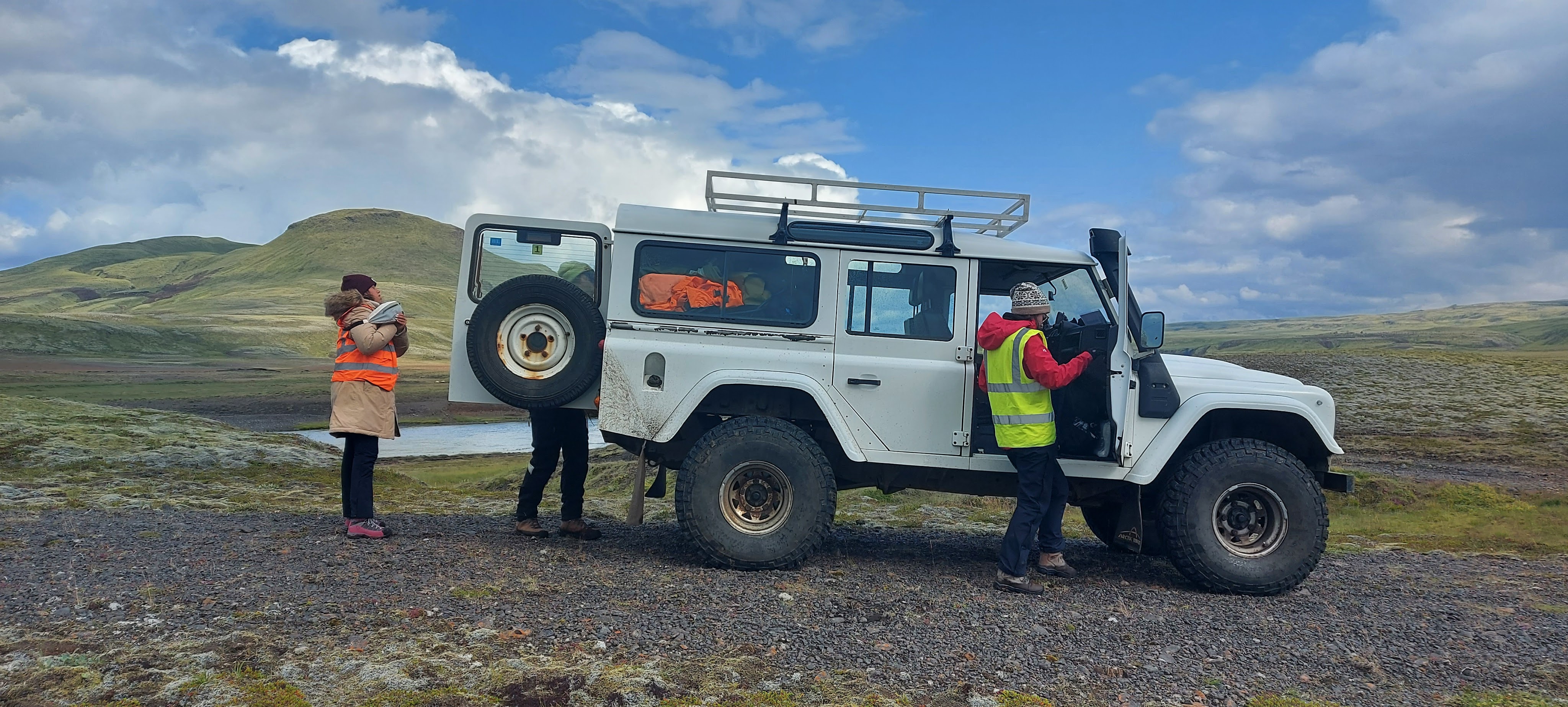
The following morning, we all convened at Askja, the University Earth Sciences building where, outside, were two beastly 4x4s: one Hilux and one old-school Land Rover Defender, which would be taking us out into the field. Will’s students would be in the Hilux driven by Iðunn, and Will, Jodie, and I would be in the Land Rover. Obviously, Will was driving as neither Jodie nor I had any off-roading experience (though that could change in the future). We spent a good two hours at Askja before heading off, as establishing food and meal plans and packing the cars with all the camping and field gear required some organisation, but soon both researchers and off-roaders were ready to go.
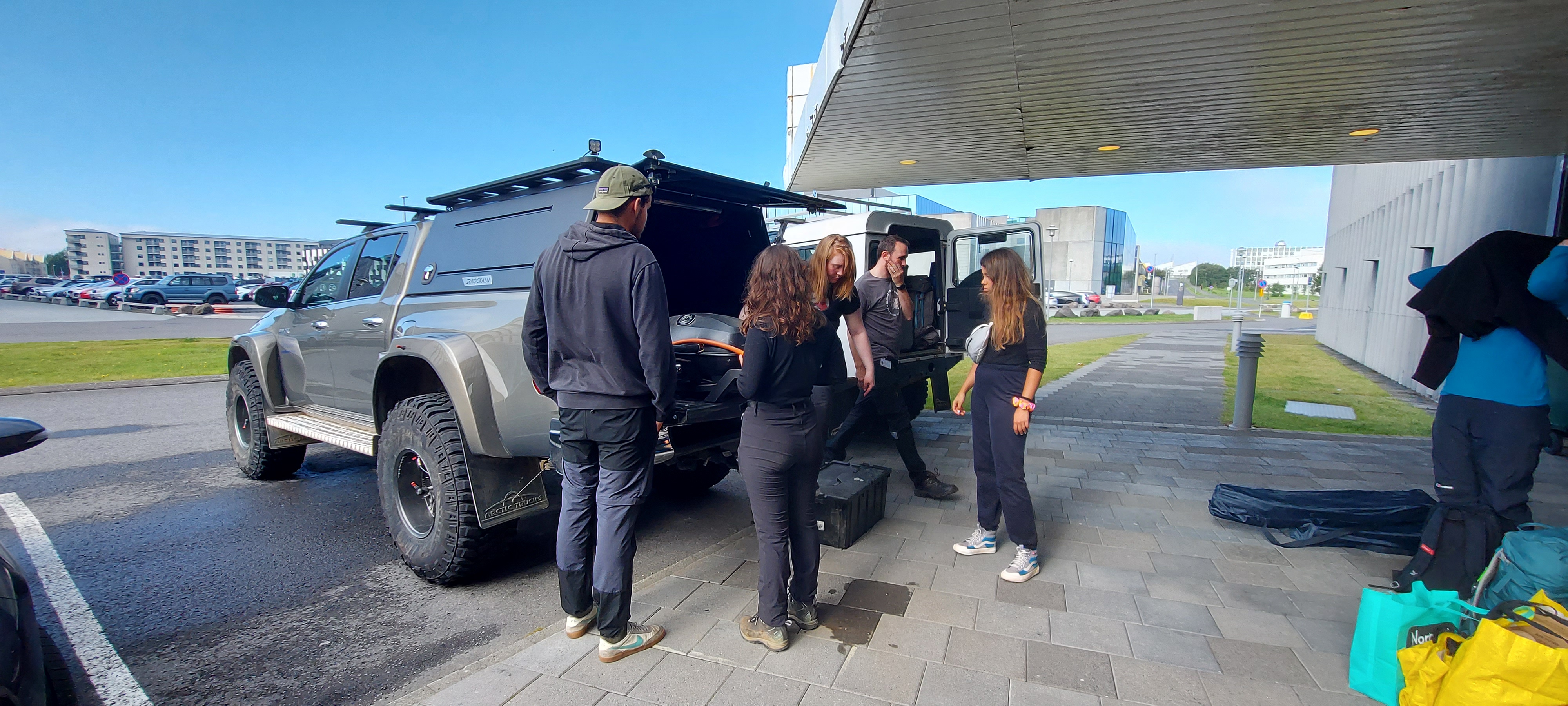
The journey to Eldgjá
The journey to Eldgjá was pretty wild: across the southern volcanic zone of Iceland, and initially following the country’s ring road until we reached our turn-in point towards. The world-famous ring road traverses over old lava fields and vast glacial outwash plains that skirt the more mountainous Icelandic interior, and passes dozens of one-time cinder cones and larger, more infamous volcanic edifices like Hekla and Eyjafjallajökull. It then skims past tourist favourite hotspots like the Seljalandsfoss and Skógafoss waterfalls, and some more recently born attractions like LAVA Centre in Selfoss. We pulled in at the reasonably well-stocked supermarket in Selfoss, but my is grocery shopping in Iceland expensive. For the 7 of us away for just 3 days (and we had come with a meal plan, to save chaos), the till bill came to more than £400, and this was apparently less than Will was expecting. Nevertheless, with all our supplies promptly loaded into the trunks of both trucks, we were on our way once again.


At the entrance to Vatnajökull National Park we turned north off the ring road, where the track becomes off-limits to any vehicle that does not have 4-wheel drive since the “Laki Road” quickly becomes the rocky, uneven terrain that Will had earlier warned us about (hence the Hilux and Defender). I felt as though I was in the backseat of a live Top Gear Special, especially when we started crossing the glacial rivers that cut through the track. Some rivers were shallow and narrow, others less so. A word about river crossings: always make sure that both normal transmission and the transfer gears are in low and that all doors are properly shut. Thankfully, both cars made all crossings without too much trouble, besides the Land Rover not being in low at the most critical point. After an hour and a half of off-roading, we finally made it to our pre-arranged remote campsite by the rangers’ hut somewhere in a Laki lava field. Having parked our vehicles in a natural clearing, we promptly set to making camp, unloading half a tonne of camping gear, food and field gear – before the sun disappeared behind ominous clouds. At last two hours later, just as the last remnant of light dipped behind the gathering clouds, we had our camp.
A word about river crossings: always make sure that both normal transmission and the transfer gears are in low and that all doors are properly shut.

It is a surreal experience to camp in a field surrounded by lava. In 1783, the whole of our surroundings would have been flowing, hot and alight, and the air would have been thick with ash and poisonous gases. The 25 km-long Laki fissure eruption (the ‘Laki Fires’) lasted over 8 months, covering an approximate 14-square-km area in basaltic lava, releasing 122 mega tonnes of sulphur dioxide and deadly amounts of fluoride gases, resulting in widespread famine in Iceland by the following year. But this eruption was nothing on the scale of Eldgjá, the largest on Earth in the last 1100 years.
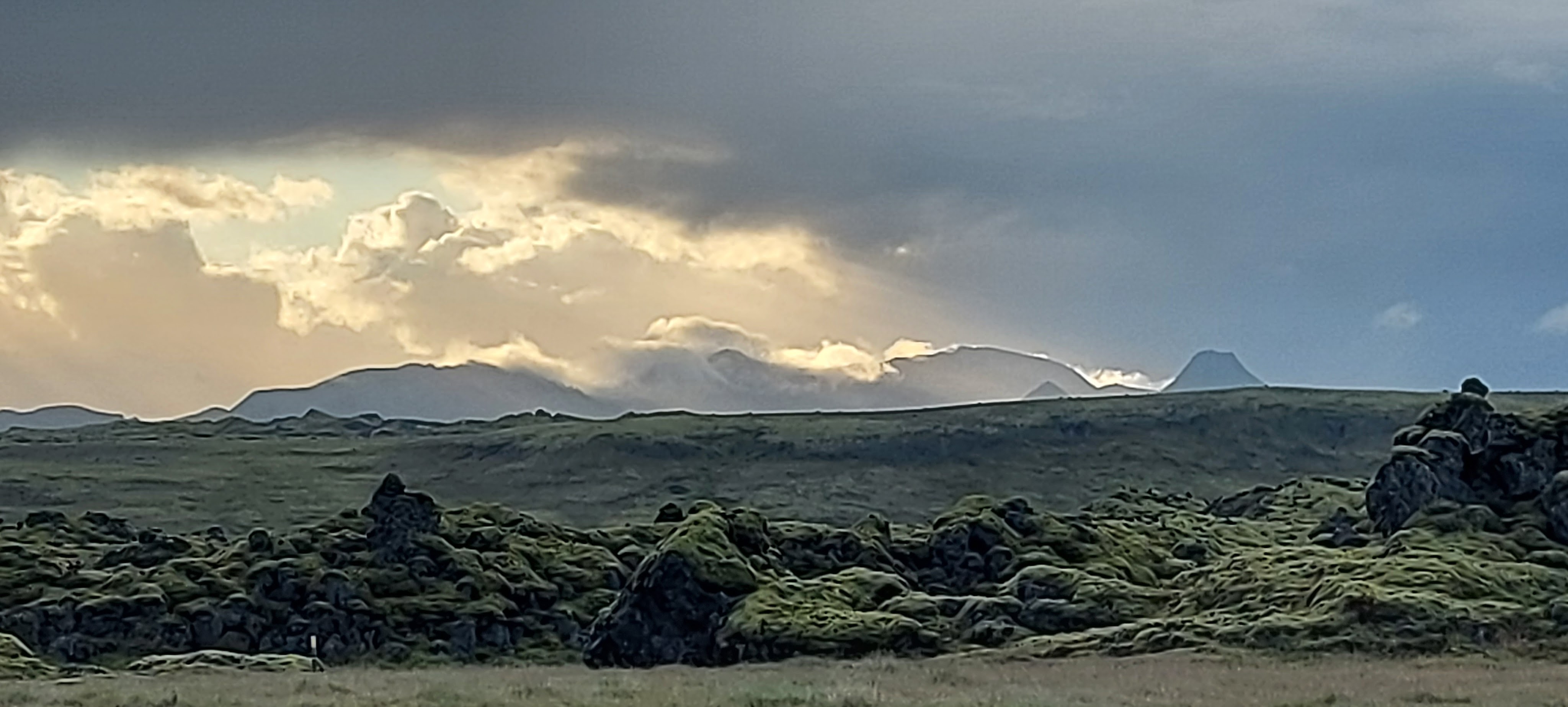
Sampling Eldgjá
Following a long journey, a late BBQ and cold and unpleasantly damp night in camp, we were now ready to head out for our target eruption: Eldgjá.
Like Laki, Eldgjá is not your ‘classic’ volcano. It does not have a grand central cone and so is not easily recognisable like Mt. Fuji, Etna or Rainier. Rather, it is a 75 km-long serious of fissures between Mýrdalsjökull, the glacier atop the vast Katla system, and Vatnajökull, the largest ice cap in Iceland, under which lie several more subglacial volcanoes. Between 933 and 934 AD, Eldgjá erupted at least 16 times, spilling basaltic lava over a vast 780-square-km area. Eldgjá’s eruptions emitted significantly more sulphur dioxide than Laki: 200 million tonnes, making it ‘the greatest known volcanic pollutant of recent history’, while 1.3 cubic kms of tephra (rock and ash) fell from the sky. A force to be reckoned with, the eruption pushed early settlers away from their lands in the south-east of Iceland. Our goal was to sample some of the tephra layers from different eruptive stages. These we would then later geochemically analyse in the lab.
“Our goal was to sample some of the tephra layers from different eruptive stages. These we would then later geochemically analyse in the lab.”
The route heading from the Laki lava field to our identified localities in the Eldgjá terrain was incredibly rocky, which made for quite a bumpy ride. The 4x4s were a necessity here as we rumbled over blocky lava and around spurious ‘rootless cones’ – small, volcanic cones borne of detached surface eruptions that Jodie and I decided to climb inside. The field was also covered in black tephra in places and juxtaposed by the black plains of glacial outwash floods, or jökulhlaups. It was two hours before we found the real ‘track’ to our target tephra layers, but Will knew what he was doing, having mapped in this area for his PhD research, many times. Eventually, we found the first locality. A quick spot of lunch in this otherworldly location, before we were off with our shovels, picks and bright yellow field notebooks to sample both rocks, and ash. Although, it wasn’t quite as simple as this, as Méline and I both got stuck in the black quicksand en route. For this, the shovels came in handy.
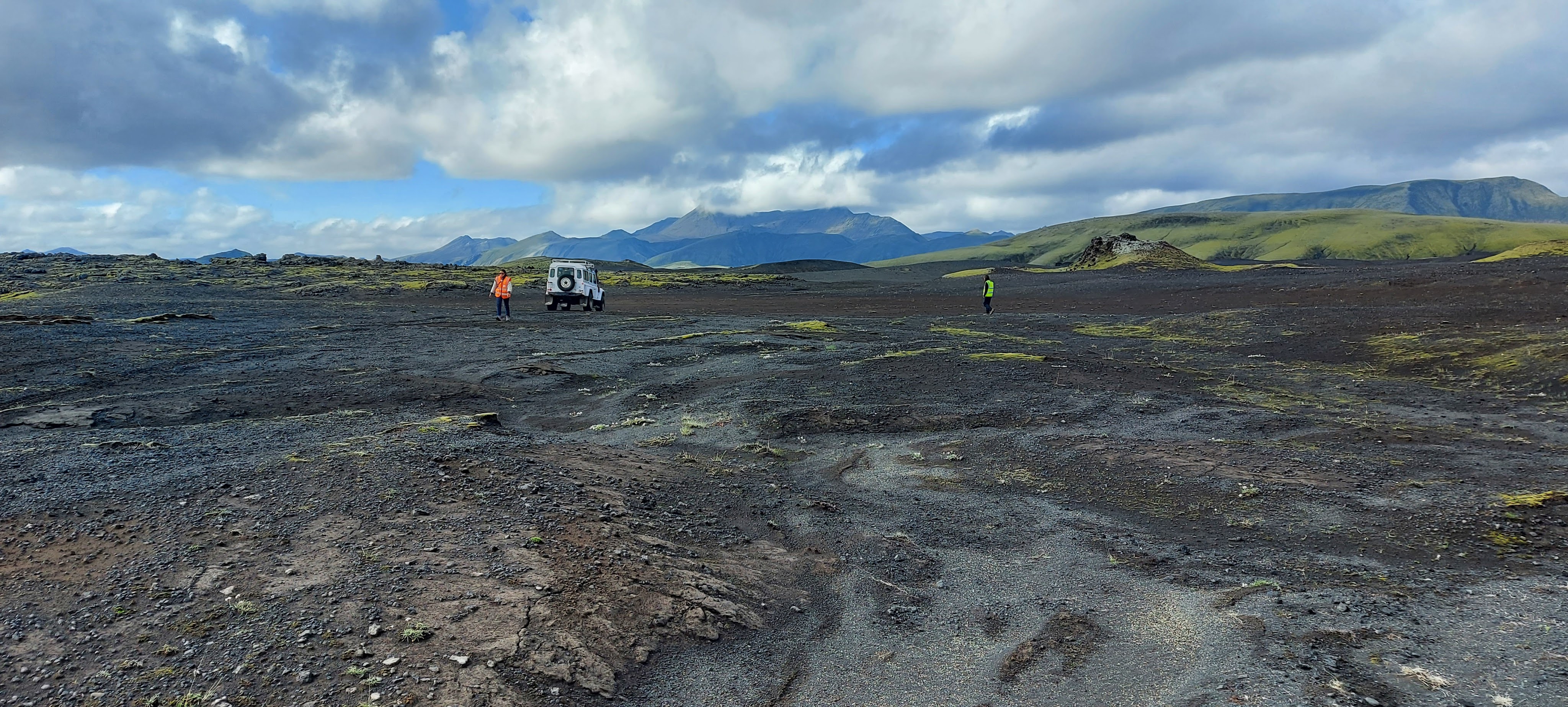


In the tufty slope of a small hill, beneath the topsoil, Will scouted out a neatly structured sequence of dark eruptive layers known to belong to the 10th century Eldgjá eruptions, above the distinctive ‘settlement’ layer. Ideally, each successive layer needed sampling, so both Will and his students showed Jodie and I how to delicately pry away soil and dirt covering our treasure until we had about a kilogram of each of about 5 layers sealed in polythene bags. Of course, Will knew which layer corresponded to which eruption, but we would have to confirm that for ourselves back in the lab later. Rucksacks loaded, we moved to the next site (for reproducibility), and so on. This was necessarily a long day in the field hopping between target localities, but spoilt with spectacular scenery wilder than the most rugged parts of Scotland. For each, it was both humbling and extraordinary to be present in such a remote location where few humans have trod. We returned to camp that evening happy and accomplished, despite the incoming rain, with dozens of photos and several kilograms of sifted ballistic tephra to show for it. Now, time for another soggy BBQ.
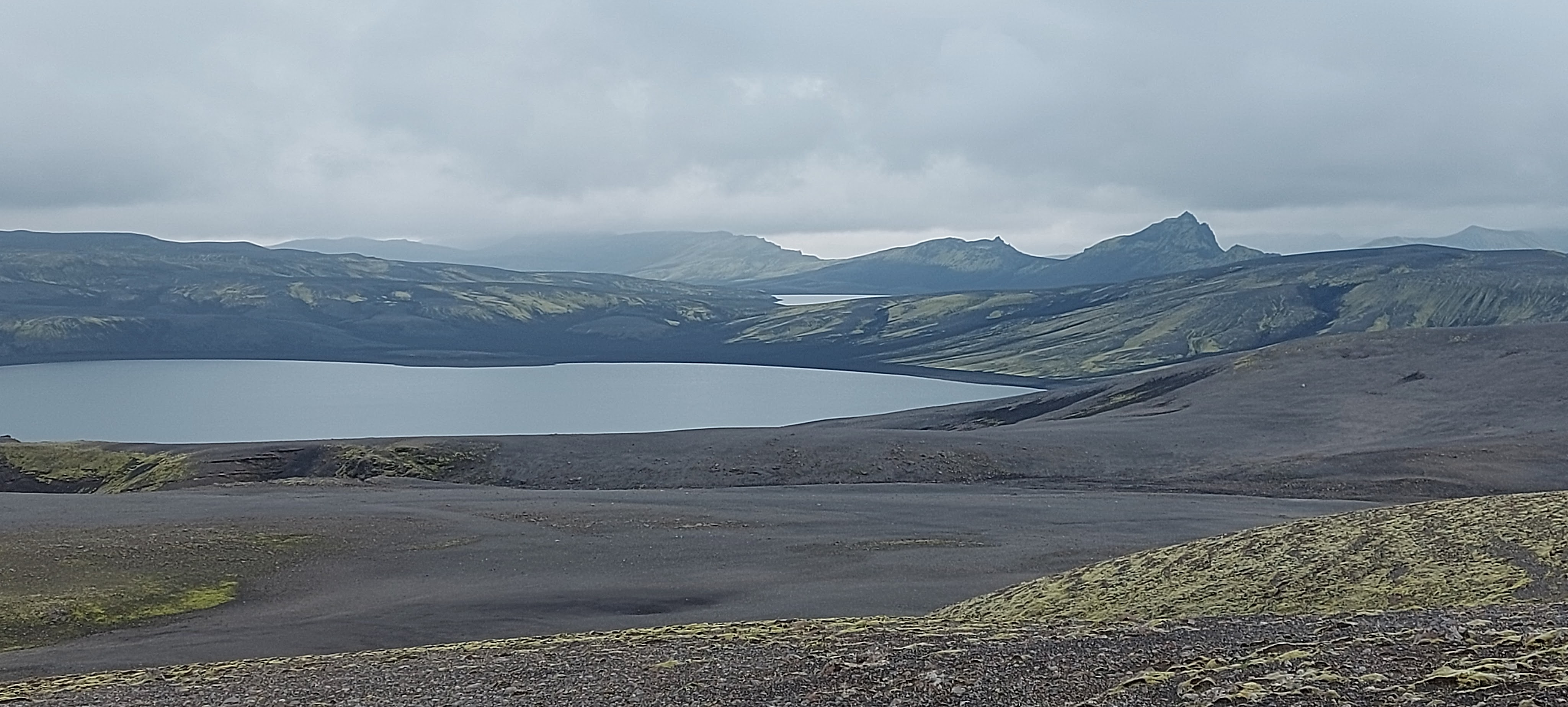
Final day in the field
The final day in the field we split the team in two. Jodie and I needed a few more layers of Eldgjá from a few more localities closer to the eruption source beneath Mýrdalsjökull. Diana came with us and Will in the Land Rover, while the other 4 disappeared off somewhere in the Laki abyss.
At first, we did not have much luck finding meaningful, or undamaged, tephra layers as hill collapse and rain had infiltrated where they should have been. However, eventually our fortune turned, and we found the perfect snapshot of Eldgjá’s eruptive history. Tucked on a hillside and with meticulous detail, Will demonstrated to Jodie and me how the Eldgjá fissures had produced alternating series of magmatic (magma-driven) and phreatomagmatic (water- or ice- as well as magma-driven) eruptions. Each layer took on slightly different shades of brown and grey and varied in texture and size of clast (suspended rock units) from the bottom, earliest layer to the final layer preserved. Using graphic logs, we recorded in our notebooks what we saw and could measure, before again delicately sampling and adding yet more rocks to our collection to take back to the labs in St Andrews, praying that Keflavík would allow them through airport security. Thankfully, there were no dramas. At Vík (a popular spot on the south coast of Iceland for tourists) on the return journey, we reconvened with the others before finally returning to Reykjavík, with overpriced roadside diner food to see us on our way.

Exploring the south of Iceland
The official part of our field trip might have been over, but for Jodie and me there was more to be seen. Our final few days in Iceland we spent as ‘regular tourists’ doing regular tourist things like taking a tour bus on the ring road to see ever-popular sights up close like the Seljalandsfoss and Skógafoss waterfalls, the Reynisfjara ‘black sands beach’ and, my personal favourite, the Sólheimajökull glacier, a tributary of Katla’s Mýrdalsjökull. For me, it was simultaneously a wonder and a concern to see just how much the glacier had retreated since I was last in Iceland in 2015. Nevertheless, nothing beats a hike on ice, and if you ever get the chance to go on one (before all the accessible glaciers in the world melt), then you definitely should.


The Land of Fire and Ice
And finally, after a little exploration of the world’s northernmost capital city, it was time to return to the UK (rocks and all), ready to embark on an even greater journey: back to St Andrews to begin the PhD proper.
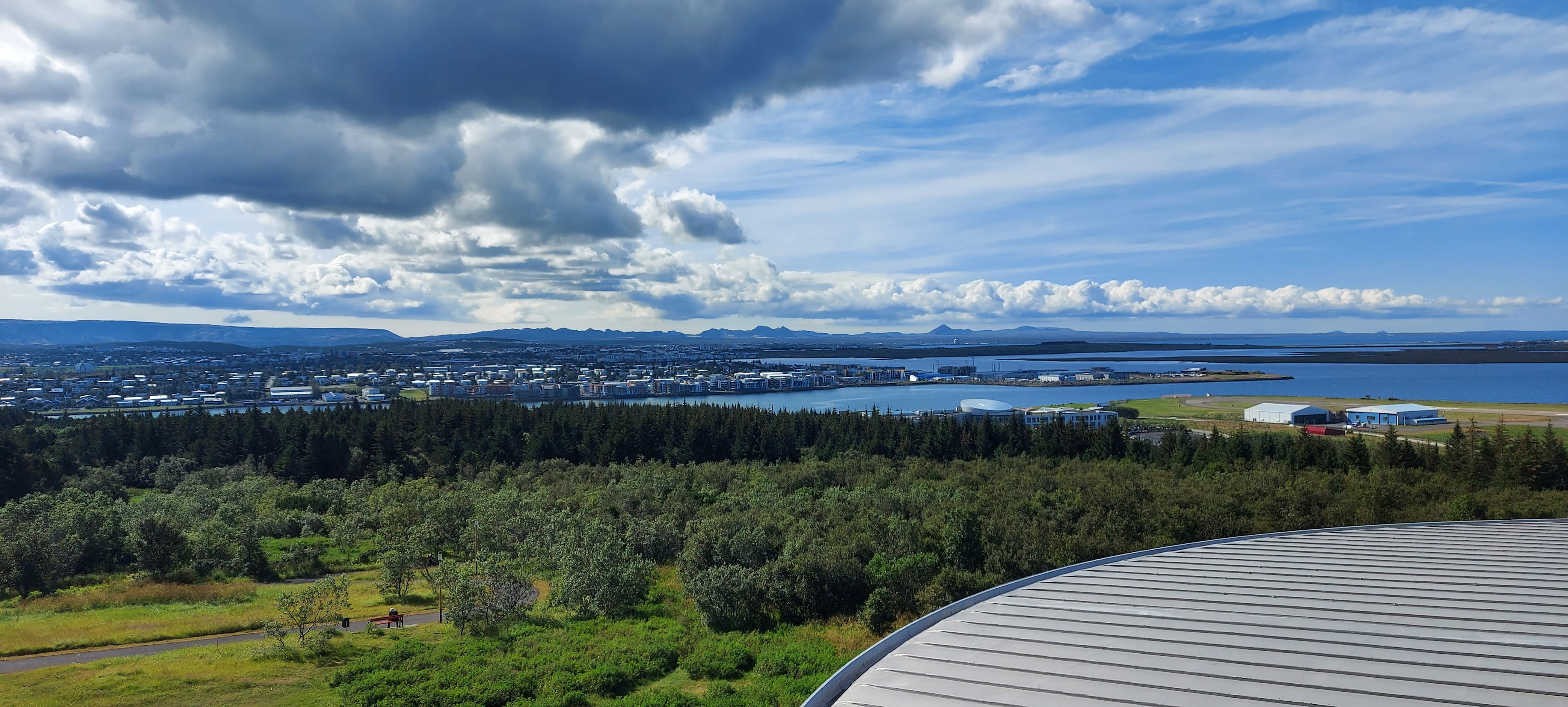
Starting with analysis of the Eldgjá tephra with Jodie, my research goal as I train as a volcanologist and geochemist over the next 3 to 4 years will be to unravel the climate-changing volcanic eruptions of the last millennia, and how they are recorded in the sulphur isotopes of ice cores at high latitudes, and I cannot think of a better way to begin this undertaking than with a week’s jaw-dropping fieldwork in Iceland, truly the Land of Fire and Ice. I cannot wait to return for more at Askja next year.
If you want to read more about the aim and details of my proposed research, check out this earlier post. And until the next time,

 Adventure Becca
2 thoughts on “PhD Adventure Files 002: Fieldwork on the Eldgjá fissure eruption, Iceland.”