One brisk Saturday in February, I embarked on my first sports climbing meet to the Isle of Portland with the Oxford University Mountaineering Club (OUMC) – a day of adrenaline, ascents, and lessons learnt on the rock.
About 40 climbers of varying levels of experience crammed into two minibuses and several volunteers’ cars, leaving the University Sports Centre early that sunny, winter morning. I clambered into Jake’s steel blue Ford Mondeo alongside Lola (my blue-eyed, and dark, curly-haired climbing friend), Beth (a surfer girl whom Lola met while on a climbing meet in North Wales in November), and Nick (a tall, lean and long-haired sport climber from Singapore). Jake we all knew as ‘Mr Biceps’ from our training sessions with him at the climbing gym. The five of us tossed our assortment of multi-coloured gear into his boot before heading down the road towards the Isle of Portland, catching up on the local climbing gossip and ‘vibing’ to Jake’s tasteful music collection along the way and eventually arriving just before midday.
We parked up above the limestone cliffs. We then picked our way down the hillside and over the detritus of recent rockfalls to access our hot-listed stretch of limestone-chert outcrop. We later found out it hosted the most highly rated climbs on the island. Portland is actually a tied island – a narrow stretch of Chesil Beach juts out under tension, like a quickdraw, from the British mainland. Geologically, Portland is revered in the UK for its superior limestone. This rock formed in the Late Jurassic when the UK bathed in the warm, subtropical seas that opened as the Pangaea supercontinent began fragmenting. In this balmy, temperate climate, tiny beads of calcium carbonate precipitated from the mineral-saturated seawater. These grains, known as ooids, deposited on the submerged rubbly reefs among prehistoric corals, oysters, and algae. With time, the ooids and reef fauna chemically cemented to form the hard Portland Limestone along with dense, silica-rich layers of shelly fossils that solidified into chert horizons. Over millions of years of tectonic movement and undulating cycles of sea-level rise and fall, the limestone and chert were raised up out of the sea into the lithologically striped cliffs found on the Dorset coast today.
Its particular geological history made the Portland Limestone weather-resistant yet easily carvable. The stone has been quarried since the 14th century, though its true history really began with St Paul’s Cathedral. The relics of centuries of voracious quarrying still pepper the island. Climbing, however, capitalises on the stone in a different way. The vertical cliff face cuts through the horizontal bedding planes, structural layers in the rock. This exposes the layers in cross-section and makes snippets of stepping stones for climbers. The rock’s texture also adds value, especially the chert – it is strong and sharp, with angular edges that provide good hooks to pull and lever your weight on, though not without causing injury, as I soon discovered.

At the cliff base, ropes, slings, quickdraws and carabiners were distributed. Gradually, these were hooked up the wall to the bolted top anchors that characterise sport climbing. The limited supply of quickdraws, used for bolting into the wall and streamlining a climber’s path of rope – proved problematic. It appeared that most of the club gear was with the other OUMC groups at a different section of the cliff, so we relied on borrowing personal gear from the club’s more experienced sports climbers. Only they would get the chance to lead climb that day and, even then, only so that top ropes could be established, sparing a subset of the quickdraws. Several lines slowly emerged on the shadowed wall, though the top undulated in and out of the winter sun. The goal was to reach that enlightened place. In the meantime, we beginners waited on the boulders, pre-fuelling with Tesco sandwiches, mini Babybels, and cherry-flavoured Jaffa Cakes. Soon, we and the wall were ready for our sports debuts.
We started on the easiest route, the beginning a case of stepping up the limestone slabs (bedding planes) as though they were stairs, until their depth diminished to narrow foot ledges marked by bands of dark chert. In many ways the wall resembled a giant barcode. Lola and Jake partnered up to climb first while I waited below wandering round the boulder scene taking photos with Yixuan, a beginner from Beijing. I was glad for the opportunity to unleash my camera into its natural habitat despite being mildly terrified that a rock should fall from the cliff and cause it to shatter! Thankfully, no such event precipitated. But soon it was time to pause taking shots of the sea, harness-up, and take shots at climbing the wall instead. After belaying another expectant (a rite of passage before your turn), I tied in, with Lola ready to belay me.

Apart from one section of the route where foot and handholds became fumbly, the chert gnarling into my untrained flesh, I sailed efficiently up the first route, touched the top bolts with satisfaction, then abseiled back down, exhilarated. Jake commented on my speed and decided to title me ‘Spider Girl’. After belaying Yixuan’s ascent, I was eager to move onto the next climb on the Portland web and for more of a challenge. With sport climbing there is scope to complete many routes in a day because the ropes and quickdraws are clipped onto permanent bolts in the wall; there is no need for gear to be placed and removed with each new route, as is the way with ‘trad’ climbing. I could already sense that sport climbing was shaping-up to become addictive. After Yixuan had scaled fluidly up and back down the first route, we quickly sought out more challenging lines.

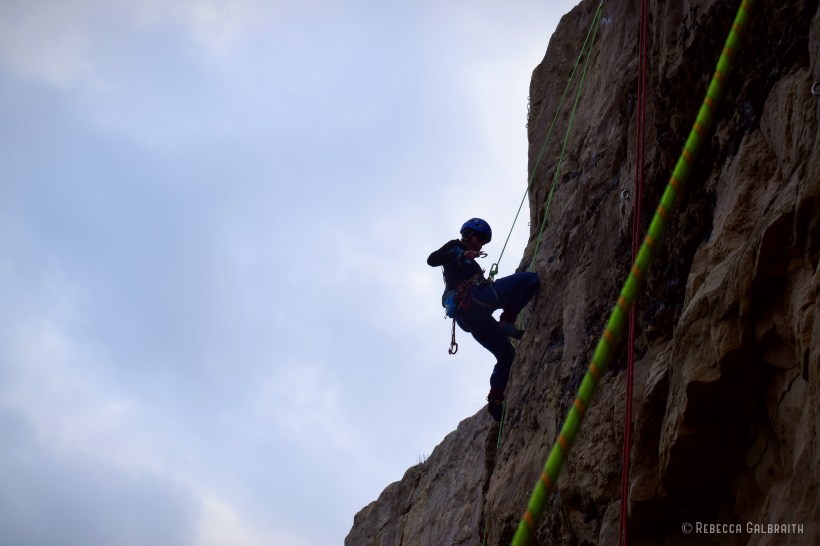
Over the course of the afternoon, fuelled by the second of my sandwiches and more Jaffa Cakes, I climbed most of the remaining routes on our commandeered stretch of cliff, committing to each with steadfast resolve. Or at least I attempted to. There was one route that neither me, Lola, nor Mr Biceps (Jake) could complete right at its final metre. We’d run out of handholds; the angular chert had petered out, the wall’s barcode stripes no more, leaving only smooth, weather-polished limestone and very little to grip. High on the cliff, the wind warping around me, I did not trust my precarious foot placements in the tiny cracks and grooves. Each newly trialled orientation of my toes only increased how awkwardly I was balanced. At the same time, I felt my surroundings enlivening to a crescendo. As though detected on radar, I now registered the caw of seagulls whose airspace I’d invaded, the crashing breakers on the boulders below, and their impacts that sent a tingling aerosol of sea spray high up the cliff. I also became suddenly aware of the numbness in my exposed extremities, my fingers especially, which struggled to crimp what little juxtaposing textures in the rock remained. So, just as Lola and Jake had done before me, I made the regretful decision to abandon the final push. Climbing is full of chances to flourish or fail, often at the crux of a route. Here, I failed to commit and push through my uncertain hand and foot placements, even though I had no real fear of falling. Moments later, Yixuan’s success put me to shame. She nailed the crux, her slender dexterity and slight, additional height giving her the edge. As she descended on belay, we all applauded her efforts. Where others had failed, she flourished.
Although I didn’t push on with that route, I tend to be mentally well-committed while climbing. My whole being is immersed in the motions of my limbs wandering above and below me. They feel their way up the wall with heightened awareness, sensing the minute variations in naked rock texture on an outcrop, or even the chalk-slickened, candy-like holds of the indoor climbing gym. All my energy and focus are channelled into unlocking the solution to the physical problem of the route. Until I took up climbing, I could never understand how climbers were so unphased by the lacerations to their hands, flesh torn en route up a malign face. However, even three relatively easy climbs in that Saturday afternoon, I had sustained some nasty cuts where chert’s teeth had bitten into my fingers as I leveraged my bodyweight skywards. But sliced and numbed with cold from the wind chill and adrenaline, I didn’t notice the damage until I was back down at cliff base. Climbing ensnares the ordinary human perception, and elevates the senses to new, sublime (or scary) heights.
Some of the challenges encountered on this, my first sports meet, were far beyond my capabilities. Jake and I partnered up to attempt a route that had been pitched at an overhang where the waves had chomped a cave several metres into the cliff base. The route started with navigating the overhang, and once you had bolstered this, there was a one-handed pull-up on a sharp slice of chert, before you thrust your spare hand into a vertical crack, half a finger in width. On each of our attempts, Jake and I kept each other tight on belay; a fall was inevitable. Unsurprisingly, neither of us made it past the first two metres, despite our assets – Jake with his biceps, me with my commitment, and both of us with the psychological aid of powdered chalk. We decided we would have to come back, more experienced, to complete this one another day.
It soon began to get dark as the February sun descended far behind the cliff and a veil of rain clouds pulled overhead. But, unlike other outdoor trips I have been on, no-one seemed concerned. Those who were willing continued climbing into dusk, grasping at the faces with whatever vestiges of light remained. I was still feeling pumped, energised and, strangely, not cold. I was keen to add at least one more climb to the day. Coaxed by another member of my party, Benjamin, I unearthed a head torch from my rucksack, strapped it to my helmet, and gazed up at the hallowed rock face, accidentally dazzling Benjamin in the process. I flicked over to the less oppressive red mode. A blonde, laid-back lad named Will, who shared his Soreen with me, was preparing to ‘clean’ (remove gear from) a route further along as the fatigued members of our party began heading back towards the car park. This route looked varied in its topology and direction, which made it exciting. I asked if I could have a go. Will agreed, provided I could clean the route in his place. Unfortunately, having only learnt how to do this in the safety of the climbing gym back in Oxford, and with time and light running out, we decided that my first time cleaning up a real route should not be on a sea cliff in the dark. A tad disappointed, I handed back the rope. But I was still eager to complete one last climb, so I joined Benjamin and asked if I could climb his route. He accepted and belayed me as I sensed my way up the shadowed wall.
Climbing in the dark is an even more immersive experience that climbing by day. Senses are intensified, strung into a primeval state, locked-in on the environment commanded by the rock. They encompass you and demand your resolute attention. Those millions of years of geological processes that constructed the rockface are reduced to minutes and seconds at your fingertips. As your increasingly straining frame pushes further upwards, muscular fatigue steadily (or sometimes exponentially) setting in, you pass through eons of deposition and erosion in their innumerable iterations. Added to this is the environmental evolution readable through each feature embedded in the rock. Here, poised on the Portland Limestone, I skimmed past the ancient reef beds and the subsurface slope planes on which they precipitated and the indentations of fossils – the fauna of forgotten ages – suspended in the strata. Every detail was a tactile surface to be explored and, potentially, exploited in aiding my climb. It was like the entire geological history of this cliff section had resurrected, ready either to drive me up further through time, or to propel me back to ground level where only the infantile geology of recent times could be engaged. I soon found out which it was to be. Normally, I have scant fear of heights, but as I now ascended through the Portland palaeoenvironment, a fear forged only in darkness emerged. Unable to see details in the rock, I had to feel my way blindly, sensitively, up the route. Here, I really needed to be Spider Girl, delicate and calculating. Nerve by nerve, I made it to within 1.5 metres of the top bolt. But there, so close to the top with only a few millennia left to surpass by touch alone, I became, psychologically, stuck. My fingers were senseless and numb, abused by overuse and the biting, offshore winds, and I just couldn’t envision myself climbing any higher. Geology decreed my decision: to abort the final move. But unlike earlier in the day, I didn’t so strongly regret my retreat. By climbing in the dark at the end of the day I was already beckoning new challenges, embracing my growing relationship with the rock. In this I learnt an important aspect of sport climbing – you cannot expect to complete all the routes you attempt immediately. However, you can be open to opportunities for exploring and pushing your limits.

Back at ground level, with the heavens turning a deep, murky teal – the kind of cloudy night sky you only get in winter – it was time to disarmour myself of the climbing gear and join Jake and Nick to clamber back over the rockfall and up the hill to the car park, where Lola and Beth were waiting. In my mind, this was the most treacherous part of the day. The rockfall was clearly a recent donation of cliff to beach. Scrambling over the boulders in the dark was a sketchy business requiring us to move quickly and carefully. We escaped unsquashed, and soon all our gear was loaded in the car, along with our suddenly fatigued, sleepy, and hungry bodies. A pitstop on our way home was in order, and Bennett’s Fish and Chips in Weymouth did not disappoint.
On the late return to Oxford, between bursts of karaoke, Lola and I remarked how wonderful the day had been. We’d completed our first sports climbs, achieving several new routes. We’d survived the chilly, winter winds, challenged ourselves on the microenvironment of the rock, and put our skills to the test, even learning to push them into the formidable territory of falling darkness. I had also entered a new relationship to be developed with Geology, becoming immersed in its spectrum of scales from the pitch of the whole outcrop as an ordered structure in time, to the fine details of its varying, textured topology – the vertical, temporal assortment of chert jugs, karstic crimps, and limestone ledges to be selected as handholds and foot placements for my hopeful benefit. Climbing, I could study the rock by engaging senses, not through dry classroom lectures. I may have paid for my adventures with my productivity, which was severely diminished the next day, but it was certainly worth it.

 Adventure Becca
Very nicely written! Whilst reading I felt like I was there back on the sea cliff stones reliving the experience of thrill and fear.
LikeLiked by 1 person